There are numerous reasons why I am excited that Kurt Wilkin has decided to share wisdom that he has gleaned from his own career of growing several successful businesses, as well as offering lessons he has learned in guiding other business owners. Kurt is a gifted storyteller. In "Who's Your Mike?" he uses his natural “down home” style to illustrate principles of how to grow a successful business to the next level of profitability. He lays out the clear and easy to understand principles. And then he is fearless in sharing through successes and mistakes, how he has come to embrace those principle for himself and his clients. I have personally benefitted from Kurt’s generous sharing of lessons learned. I am excited that now a broad readership will have the same opportunity as those of us who know him personally.
Friday, August 19, 2022


Monday, March 28, 2022
Updating the Role of Chief of Staff - A Timely Republication

Here is an example of this role in practice:
COS calls Brand Manager for Brand XYZ:
“Tony, this is Sharon. We agreed that next Tuesday you would meet with Bob to report on progress in changing the packaging. You mentioned in your weekly report that your design team is three weeks behind in agreeing upon a new package. I know that Bob is very concerned that if we can’t deliver the next packaging on schedule, we are going to lose more market share. I know your meeting next Tuesday will go well if you come with a specific plan for how to get this project back on track before the next Board meeting. See you Tuesday at 9:00."
It would take a pretty extraordinary individual to be able to juggle all of these balls, satisfy all of the key stake holders, massage sensitive egos and do it all with efficiency and grace. Such an individual would have to have developed a robust set of hard skills and soft skills. In the next section, we will take a look at these specific skills and intangible traits needed to be an outstanding Chief of Staff.
Chief of Staff - A Force Multiplier
Chief of Staff - A Force Multiplier
Chief of Staff - A Force Multiplier
Part V - Final Thoughts
- The CEO wins because he is freed up to be able to concentrate his time, effort and priorities of strategic initiatives. He is empowered to “keep the main thing the main thing”!
- The organization wins because its leader is leading more effectively and the COS role is adding to succession planning by attracting, grooming and retaining an unusually gifted up-and-coming leader.
- The Chief of Staff wins because his/her career trajectory is raised and he/she is able to make a major contribution while being mentored and groomed by a seasoned leader.
Searching for A Unicorn - Chief of Staff to Support the CEO of a Growing Tech Company in San Francisco

I recently republished a White Paper on the role of the Chief of Staff in the private sector. What prompted this republication was a search I am conducting to fill a newly created COS role for a rapidly growing San Francisco based company.
If you have alread served as a COS or aspire to the role, please consider applying. This CEO is a visionary who is willing to mold someone fairly early in their career.

Duties of the Chief of Staff:
- Serve as a strategic resource in support of the CEO
- Carry out specific projects that will be assigned by the CEO
- Serve as an extra set of eyes and ears in meetings - inside and ouside the company
- Ensure that benchmarks and deadlines are reached
- Serve as a soundingboard for the CEO as decisions are arrived at
- Optimize communication between the CEO and direct reports
- A track record of superior achievement and promotion
- Excellent communication skills - verbal and written
- Project management skills and experience
- Strategic thinking
- Creativity
- Emotional intelligence
- Flexibility
- Coachability
- Diplomacy skills
- Leading through influence and consensus
- Integrity
- A sense of adventure
- Basic knowledge of the tech start-up world, through experience or robust reading, for example:
- "The Lean Startup" by Eric Ries
- "Zero to One" by Peter Thiel
- "The Hard Thing about the Hard Things" by Ben Horowitz
- Position is based in San Francisco. The company will pay to move the right candidate who is not currently living in the Bay area.

- Here are some of the things the CEO said in setting the parameters for the COS search:
- "In hiring executives, I look for fascinating and interesting people. Please don't send me any boring MBAs!"
- "Candidates do not necessarily have to come from the tech world, but they should have basic knowledge of the tech startup ecosystem. If a candidate did not know who Ben Horowitz is, that would be a concern."
- "In building my team, I look for individuals with diverse backgrounds."
Friday, October 23, 2020
"Caste" by Isabel Wilkerson - "The Origins of Our Discontents"

Isabel Wilkerson established herself as a writer of significant influence with the publication of her landmark work, "The Warmth of Other Suns." This seminal work chronicles the Great Migration of post-Civil War blacks northward to the industrial centers of Chicago, Detroit, New York, et al. In her most recent book, she examines racism in the light of the concept of caste. The subtitle of "Caste" is "The Origin of Our Discontents."
Wilkerson examines three caste systems: India, Nazi Germany, and the United States. Linking these three societies together is not something I would have been able to do on my own, with the author leading the way toward new levels of awareness with her insights and anecdotes. I had chills when I read that when the Nazis came to power in Germany, they wondered how to cement their cultural views of racial purity into a well synchronized legal system They turned to the Jim Crow laws of the post-Civil War South as their template:
"By the time that Hitler rose to power, the United States 'was not just a country with racism,' Whitman, the Yale legal scholar wrote, 'it was the leading racial jurisdiction - so much so that even Nazi Germany looked to America for inspiration.' The Nazis recognized the parallels even if many Americans did not." (p.81)
The author does an excellent job of making her case for racism being a form of caste by sharing the Eight Pillars of Caste that can be found in the three societies examined in this book.
Pillar Number One: Divine Will and the Laws of Nature
Pilar Number Two: Heritability
Pillar Number Three: Endogamy and the Control of Marriage and Mating
Pillar Number Four: Purity versus Pollution
Pillar Number Five: Occupational Hierarchy
Pillar Number Six: Dehumanization and Stigma
Pillar Number Seven: Terror as Enforcement, Cruelty as a Means of Control
Pillar Number Eight: Inherent Superiority versus Inherent Inferiority
The author spends the remaining 200 plus pages offering specific examples of how these eight pillars have undergirded the particular caste systems in India, Nazi Germany, and the U.S. In a very moving Epilogue, Wilkerson shares how Albert Einstein served as a bridge between the caste systems of Germany and the U.S. After fleeing the antisemitism of Nazi German's caste system, Einstein settled in Princeton, New Jersey. He was shocked to find that he had not completely escaped the depredations of caste:
"In America, Einstein was astonished to discover that he had landed in yet another caste system, one with a different scapegoat caste and different methods, but with embedded hatreds that were not so unlike the one he had fled"
'The worst disease is the treatment of the Negro,' he wrote in 1946. . . . He could 'hardly believe that a reasonable man can cling so tenaciously to such prejudice.'"(p. 378)
When Einstein and his wife learned that acclaimed opera singer Marian Anderson was denied lodging at the local Nassau Inn, they welcomed her to stay in their home, beginning a friendship that endured until Einstein's death. His awareness of the parallel between the oppression of Jews in Germany and blacks in America awakened in him a strong sense of responsibility to act.
"And so he did. He co-chaired a committee to end lynching. He joined the NAACP. He spoke out on behalf of civil rights activists, lent his fame to their causes." (p. 379)
The parallel to our day is striking. As the Black Lives Matter movement has grown in the wake of countless examples of death and injury from police brutality, like Einstein in post WWII America, leading lights in academia, sports, the arts, and politics are using the bully pulpits afforded them by their fame to speak and act against the invidious aspects of racism that persist to our day.
Enjoy!
Al
"Born A Crime" by Trevor Noah - A Moving Memoir of an Early Life under Apartheid

I have enjoyed Trevor Noah's comedy and commentary for several years. I was aware that he was South African by birth, but knew very little of the story of his early life. "Born A Crime" is a wonderfully realized memoir that offers a vulnerable and self-effacing window into what it was like to survive as a mixed race young man in the harsh days under Apartheid.
Noah's mother is black; his father is a white Swedish ex-pat living in South Africa. Under the laws of Apartheid, any kind of miscegenation was against the law, so Noah's parents had to keep their relationship under the radar of government and nosy neighbors. It took great effort for Trevor to have any kind of a relationship with his father, who lived in another community from where he and his mother resided.
The author is very transparent about how challenging it was for his mother to raise a rambunctious and rebellious young man. Noah lived on the borders of several worlds - never completely fitting in. He did not neatly fall into any of the legal racial categories, and he had to work hard at creating a place for himself among Blacks, Whites, and Coloreds. He reveals that his mastery of several languages became the skeleton key that opened doors for him to relationships with virtually every segment of South African society. The fact that he became a popular DJ whose services were in demand also opened doors for him.
A vivid memory that the author shares reveals how his natural curiosity led to disastrous consequences. He loved to experiment with how a magnifying glass could concentrate the rays of the sun to heat up a variety of objects. One day he was visiting the home of a white friend, and after showing his friend the trick with the magnifying glass, Trevor and his host went off to explore other adventures. They left the magnifying glass where it was, and unbeknownst to Trevor, the magnifying glass heated an object which eventually ignited the garage, and ultimately the entire house. This misadventure of burning down a house owned by Whites was only one of the many reasons that Trevor and his mother needed to keep a low profile.
Noah credits his mother's strict discipline with laying a foundation that has led to his subsequent success in life. She was able to do this despite facing many obstacles - financial, legal, and relational. The author leaves an indelible impression of how his mother's second husband became increasing more abusive as his alcoholism and paranoia escalated. The dysfunctional relationship climaxed in the stepfather shooting Noah's mother in a fit of jealous rage. She somehow survived being shot in the face.
Prior to reading this moving memoir, my knowledge of Apartheid was on a macro level - being repulsed by the inhumanity of the policy. The book offered me a micro look at how its laws and practices dramatically impacted the life of one young man and those within his orbit. The book is a welcome gift to anyone who seeks to understand how someone who falls between the cracks can learn to navigate the world and achieve fame. Noah uses his fame as a platform to educate and illuminate - a magnifying glass, if you will, that heats up our appreciation of the intricacies of life under Apartheid.
Enjoy!
Al
Wednesday, September 02, 2020
"Friday Forward" by Robert Glazer - 52 Nuggets of Inspiration

A year ago, Robert Glazer published a bestselling book that shared wisdom about pushing beyond limits for ultimate success and performance. See White Rhino Report review below:
Review of "Elevate" by Robert Glazer
Even before writing "Elevate," Mr. Glazer had an idea to share some of the best examples from a weekly column he has been writing since 2015. His initial motivation in writing the column was to address each of the employees of his company, Acceleration Partners. His idea was to plant a seed of an idea at the end of each week that would help his employees to enjoy a more restful and refreshing weekend. He soon learned that his employees were sharing the columns with friends and family. Before long, a subscription list grew to over 200,00 individuals from 60+ nations. The topics for the weekly Friday Forward columns consisted of issues that the author himself was interested in learning or exploring in greater depth.
As Glazer began to consider how best to organize and cull from the hundreds of columns he had written over the years, he settled on four Capacities: Spiritual Capacity, Intellectual Capacity, Physical Capacity, and Emotional Capacity. Each of the four sections of the book contains thirteen short columns - nuggets! - illustrating how Glazer or individuals he was aware of had struggled to master an aspect of each of the Capacities. In the Spiritual Capacity section, the author shared thoughts on "A Dad's Influence":
"I have found that one of the most powerful aspects of being a father is seeing the world through the eyes of my children. That lens has become a critical filter for decision-making and thinking about the examples I want to set. It also serves to remind us that the 'do as I say, not as I do' method of parenting or leadership will eventually hit a wall. My kids have become quite good at pointing out my own hypocrisies (i.e., 'Dad, put your phone down!') p. 25
One of the reasons that I chose to share the excerpt above, it that it serves as an excellent example of the author's transparency and humility. In sharing how he himself has overcome areas of struggle and deficiency, he explicitly gives each reader permission to acknowledge areas of weakness and vulnerability, and then to move intentionally beyond them.
In addition to enjoying these 52 selected vignettes, I encourage you to sign up to receive the weekly Friday Forward columns:robertglazer.com/join.
This is the kind of book that would make an excellent gift to clients, employees, family members, and friends.
Enjoy!
Al
Friday, August 07, 2020
Calling All Passionate Readers - Announcing A New Virtual Book Club: 99 Pages
My friend, Rajiv Srinivasan, shares with me a profound love of reading. I was thrilled when I heard from him last week and learned that he would be moderating a new on-line virtual book club called 99 Pages, hosted by YouTube. The concept is simple; each Sunday evening at 7:30 ET/4:30 PT, members will sign onto the YouTube live channel for an hour discussion of the current book selection. Each week, the members are expected to have read 99 pages of the book.

The current book is "Five Days - The Fiery Reckoning of an American City" by Wes Moore with Erica L. Green. The first session of the club took place last Sunday evening. Rajiv had carefully picked four panelists to lead the discussion. Other members of the club were able to chime in via chat with questions and comments.The theme of the book is the five days of rioting and unrest that followed the death of Freddie Gray at the hands of the Baltimore Police in 2015. Each panelist had a unique perspective, which led to a well balanced discussion. Rajiv did a fine job of balancing the contributions of the four panelists with the chat comments and questions that the larger group was contributing.
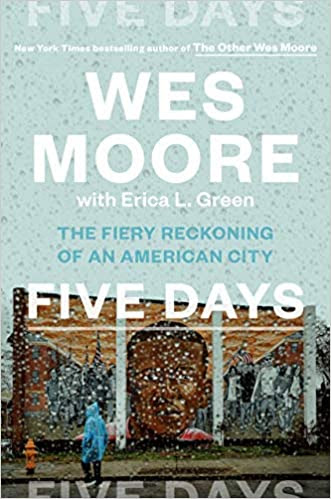
Here is Rajiv's description of his vision for 99 Pages:
"99pages is on a mission to make reading FUN and ACHIEVABLE for everyone. Each week, we read no more than 99 pages of a book, and discuss on a livestream bookclub broadcast with expert panelists and Q&A. Subscribe at 99pagesclub.com"
On behalf of Rajiv, I invite you to sign up and join us this Sunday evening - even if you have not already had a chance to procure "Five Days." You will benefit from the discussion, and can catch up with the book next week.
ex libris!
Enjoy!
Al
Wednesday, June 24, 2020
Dear Baseball - A Plea from Guest Blogger Jesse Skaff